
How the Pareto Principle Can Reshape a Small Business
Every small business owner knows what it feels like to be pulled in twenty directions at once. Orders to fill, jobs to schedule, emails to answer, social media to feed, supplies to reorder, bookkeeping to catch up on, and a list of “someday” ideas that never gets shorter. The natural response is to work harder and try to give everything equal attention. But equal attention is rarely the right answer, because not everything in your business matters equally. Some efforts carry the whole operation. Most do not.
That is the core idea behind focusing on the vital few, and it rests on one of the most useful observations in business thinking: the Pareto Principle.
Where the Idea Comes From
In the 1890s, the Italian economist Vilfredo Pareto noticed that roughly 80 percent of Italy’s land was owned by about 20 percent of the population. Looking at other countries and other data, Pareto kept finding the same lopsided pattern. A small share of causes accounted for a large share of results.
Decades later, the quality management pioneer Joseph Juran took Pareto’s observation and applied it to manufacturing. Juran noticed that most product defects came from a handful of causes and coined the phrase “the vital few and the trivial many” to describe it. Juran later softened “trivial many” to “useful many,” which is a fairer description. The smaller tasks are not worthless. They simply do not deserve first claim on your time.
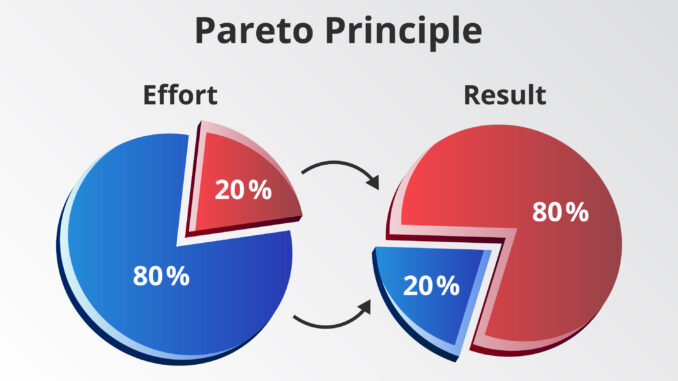
Juran named the pattern after Pareto, and today it is commonly called the 80/20 rule: roughly 80 percent of your results tend to come from roughly 20 percent of your efforts, customers, products, or activities.
A Word of Honesty About the Numbers
The 80/20 split is a rule of thumb, not a law of nature. In your business, the ratio might be 70/30, or 90/10, or something else entirely, and the two numbers do not have to add up to 100. What matters is the underlying truth: outcomes are almost never evenly distributed. When you look closely at where your money, your headaches, and your growth come from, you will almost always find that a small number of things do most of the work.
The point of the principle is not to hit a magic ratio. The point is to go looking for the imbalance so you can act on it.
What “Focusing on the Vital Few” Actually Means
Focusing on the vital few is a practical discipline built on three steps.
- First, measure. You cannot find your vital few by gut feeling alone. Pull your sales records, your job history, your customer list, your time log, or your complaint history, and look at what the numbers say. Many owners are surprised by what they find.
- Second, identify. Sort what you have measured from biggest impact to smallest. Which products or services bring in the most profit, not just the most sales? Which customers return again and again? Which marketing channels actually produce buyers? Which problems cause most of your refunds, callbacks, or wasted hours?
- Third, reallocate. Once you know your vital few, give them more of your best time, energy, and money. Then decide what to do with the rest: simplify it, automate it, delegate it, raise its price, or drop it altogether.
This is not about working less. It is about pointing your limited hours at the places where they return the most.
Applying the Vital Few in Cottage and Product Businesses
The principle is easy to agree with in theory and harder to apply in practice. Here is how it plays out in a variety of small, home-based, and product-driven businesses.
The Home Baker
A cottage baker selling at a weekend farmers market might offer fifteen different items: several breads, cookies, pies, muffins, and seasonal specials. After tracking three months of sales, the baker finds that sourdough loaves and cinnamon rolls account for most of the revenue and nearly all of the repeat customers. Several other items sell slowly, take hours to prepare, and often go home unsold.
By trimming the menu to the strongest sellers plus one rotating seasonal item, the baker cuts prep time, reduces waste, and becomes known for the things done best. Customers start coming to the booth specifically for those rolls, which is exactly the reputation a small bakery wants.
The Handmade Jewelry Maker
An artisan jewelry maker lists dozens of designs online. A review of sales shows that a small group of pieces, perhaps one signature style of pendant, brings in most of the income. It also turns out that a few wholesale boutique accounts produce more steady revenue than hundreds of one-off retail sales combined.
Focusing on the vital few, the artist develops variations of the signature style, photographs those pieces more carefully, and invests time in nurturing the best boutique relationships. Designs that never sell are retired, freeing up materials and inventory space.
The Soap and Candle Maker
A maker of handcrafted soaps and candles might discover that three scents account for the majority of sales, and that customers who buy gift sets spend far more than those who buy single bars. The numbers also show that one craft fair produces more sales than the other four combined.
The vital few become clear: the top scents, the gift sets, and the best event. The maker keeps those fully stocked, builds holiday marketing around gift sets, and stops paying booth fees at the fairs that barely break even.
The Online Product Seller
A small business selling products through its own website and a marketplace like Amazon or Etsy may find that most traffic and sales come from a handful of listings, and that one or two search terms bring in most of the buyers. Meanwhile, the owner has been spending hours each week updating dozens of listings that rarely sell.
Here the vital few are the best-performing product pages and the keywords that drive them. Improving the photos, descriptions, and reviews on those few listings often produces more new revenue than creating a pile of new ones. It also makes sense to make sure the basics behind those top products, such as accurate product information and proper retail barcodes, are solid, because a problem with a best seller costs far more than a problem with a slow one.
Applying the Vital Few in Service Businesses and the Trades
Service businesses sell time, skill, and travel rather than inventory, but the same imbalance shows up just as clearly. A few clients, a few job types, and a few referral sources usually carry the business.
The Small General Contractor
A small contractor with a crew of three or four might take on everything from kitchen remodels to fence repairs to room additions. A review of a year’s jobs shows that bathroom and kitchen remodels produced most of the profit, while small repair jobs and one-off odd requests tied up the crew, required extra trips to the supply house, and barely covered their costs.
The records also show that most of the best jobs came from two sources: referrals from past clients and a relationship with one local real estate agent. The paid online ads brought plenty of calls, but most were price shoppers who never hired the company.
Focusing on the vital few, the contractor positions the business as a kitchen and bath specialist, puts marketing effort into asking past clients for referrals and reviews, and strengthens real estate and designer relationships. Small repair calls get referred to a trusted handyman service, which returns the favor with remodel leads. The result is fewer jobs, but larger and more profitable ones.
The Handyman Service
A handyman business often says yes to everything, and that is exactly how the week fills up with low-paying, scattered work. After tracking jobs for a few months, one owner realizes that a small group of clients, mostly property managers and a few older homeowners who call repeatedly, accounts for most of the income. Certain job types, such as drywall repair, door and fixture installation, and move-out turnovers, turn out to be quick, profitable, and in steady demand.
Meanwhile, driving across town for a single twenty-minute repair costs more in fuel and time than it pays.
The vital few become the repeat clients, the most profitable job types, and the closest service area. The owner sets a minimum service charge, offers property managers priority scheduling, and groups small jobs into half-day or full-day visits. Some handyman businesses in this position create a simple “honey-do list” package, where homeowners save up several small tasks for one scheduled visit, which turns scattered calls into efficient, predictable work.
The Landscaping and Yard Maintenance Company
A small landscaping business might offer mowing, trimming, cleanups, irrigation repair, tree work, and design installations. The numbers show that recurring monthly maintenance contracts provide the steady income that pays the bills, while irrigation repairs and seasonal installations produce the highest margins. Tree work, on the other hand, requires expensive equipment and insurance, happens only occasionally, and carries the most risk.
The vital few are recurring maintenance contracts and irrigation work. The company focuses on building dense routes of maintenance clients in the same neighborhoods, offers irrigation checkups to every maintenance customer, and refers larger tree jobs to a specialist. Dense routes mean less windshield time and more billable hours in the day.
The Plumber or Electrician
A one-truck plumbing or electrical business may find that most of its revenue comes from a handful of services, such as water heater replacements, panel upgrades, or fixture installations, and from a small number of loyal customers, builders, or property managers. At the same time, a few service calls, often the vague “something is making a noise” type, can eat up hours of diagnosis time that is hard to bill fully.
Applying the principle, the owner sets a clear diagnostic or trip fee, stocks the truck with parts for the most common high-value jobs so they can be finished in one visit, and builds maintenance agreements with the best repeat customers. Being fully prepared for the vital few jobs is often worth more than being partly prepared for everything.
The Heating and Cooling Technician
In a hot climate, a small HVAC company’s busy season can be overwhelming, and the slow months can be lean. A close look at the records may reveal that customers enrolled in seasonal tune-up plans are the most profitable over time. They book maintenance during slower months, trust the technician’s recommendations, and call the company first when a system fails.
The vital few are those maintenance plan members. The company markets the plan heavily, schedules tune-ups ahead of the peak season, and gives members priority when emergencies hit. This smooths out income across the year and builds a loyal base that competitors have a hard time pulling away.
The Painting Contractor
A small painting company may take both interior and exterior work, residential and commercial. After reviewing past jobs, the owner learns that interior repaints for homeowners who are preparing to sell produce the best combination of speed, profit, and referrals, while large exterior jobs are weather-dependent and often run over schedule.
The company focuses its marketing on real estate agents and homeowners getting ready to list, creates a fast-turnaround pre-sale painting package, and schedules exterior work only during the most reliable weather windows. A clear specialty also makes the business easier to recommend.
The Pool Service Company
A pool service business might find that its weekly maintenance route produces steady income, but equipment repairs and replacements, such as pumps, filters, and heaters, deliver most of the profit. Customers on weekly service are also the ones most likely to hire the company for those repairs.
The vital few here are route density and repair upgrades. The owner builds routes clustered by neighborhood, trains technicians to spot and report worn equipment during regular visits, and follows up promptly with repair quotes. Each regular visit becomes an opportunity rather than just a chore.
The House Cleaning Service
A one- or two-person cleaning business might serve thirty clients. A close look shows that a small group of recurring weekly and biweekly clients produces most of the income, while a handful of occasional clients cause most of the scheduling headaches, last-minute cancellations, and payment delays.
The response is to protect the best recurring clients with priority scheduling, ask them for referrals, and set clearer policies or higher rates for occasional one-time jobs. The result is a more predictable calendar and steadier income.
The Mobile Dog Groomer
A mobile groomer might realize that most of the fuel costs and lost time come from a few clients located far outside the main service area. At the same time, a cluster of clients in two neighborhoods books regularly and refers friends.
Focusing on the vital few means concentrating marketing on those neighborhoods, scheduling routes by area, and adding a travel fee for distant appointments. Fewer miles, more appointments per day, and better margins follow.
The Freelancer or Professional Service Provider
Whether you are a bookkeeper, graphic designer, tutor, or consultant, the pattern is the same. A few clients typically produce most of your income, and a few difficult clients produce most of your stress. A few types of projects are both profitable and enjoyable, while others drag on and pay poorly.
Identifying those differences lets you raise rates on low-value work, specialize in the projects you do best, and seek out more clients who look like your best ones.
A Common Thread for Service Businesses
Across contractors, handyman services, and other trades, the vital few usually show up in the same places: a small group of repeat or referral clients, a few job types that are both profitable and efficient, a tight service area that keeps drive time low, and one or two referral sources that consistently send good work. Service owners who identify those patterns and build their schedules, pricing, and marketing around them often find they can earn more while working fewer scattered, frustrating hours.
Finding the Vital Few in Your Own Business
- You do not need special software to get started. A notebook or a simple spreadsheet will do. Try asking yourself a few questions and answering them with real numbers rather than impressions.
- Which 20 percent of my products, services, or job types bring in the most profit? Which customers buy or book most often and spend the most? Which marketing efforts and referral sources actually lead to sales, and which just keep me busy? Which tasks, trips, or jobs eat up the most hours while producing little in return? Which recurring problems cause most of my refunds, callbacks, complaints, or wasted materials?
- Look at a few months of data if you can, since a single week can be misleading. Seasonal businesses, from bakeries to HVAC companies, should compare like seasons to like seasons.
What to Do With the Trivial Many
- Once you find your vital few, the remaining tasks, products, and jobs do not simply disappear. You have several options.
- You can eliminate them. Some products, services, or events are simply not worth continuing.
- You can simplify them. A slow-selling item might stay on the menu in a smaller, easier version, and a low-margin service might be offered only as part of a package.
- You can automate them. Email receipts, appointment reminders, scheduling, inventory alerts, and social media posting can often run with little attention once set up.
- You can delegate or refer them. Even a few hours of help each month with packaging, cleaning, or bookkeeping can free you for higher-value work, and passing unsuitable jobs to a trusted colleague often earns referrals in return.
- You can reprice them. If a service is a hassle but customers still want it, charging what it truly costs you, through a minimum charge, trip fee, or rush rate, can turn a drain into a worthwhile offering.
Common Mistakes to Avoid
The Pareto Principle is powerful, but it can be misused. One mistake is confusing revenue with profit. A product or job type that brings in plenty of money but has thin margins may be less vital than a quieter offering with healthy returns. Another mistake is cutting too quickly. Some low-earning items play a supporting role, such as bringing customers to your booth, rounding out a gift set, or opening the door to a larger job later, so consider their indirect value before dropping them.
It is also worth revisiting your analysis regularly. Customer tastes change, markets shift, and today’s vital few may not be next year’s. A quick review each quarter or each season keeps your focus aligned with reality.
The Bottom Line
Small business owners, whether they bake bread, make jewelry, fix faucets, or build kitchens, rarely lack effort. What they often lack is time, and time spent evenly across everything is time spent inefficiently. The Pareto Principle offers a simple, practical lens: find the small number of products, services, customers, and activities that drive most of your results, and give them the attention they deserve.
You do not have to do everything. You have to do the right few things well. That shift in thinking can mean more profit, less stress, and a business that grows around its genuine strengths rather than being spread thin across everything at once.